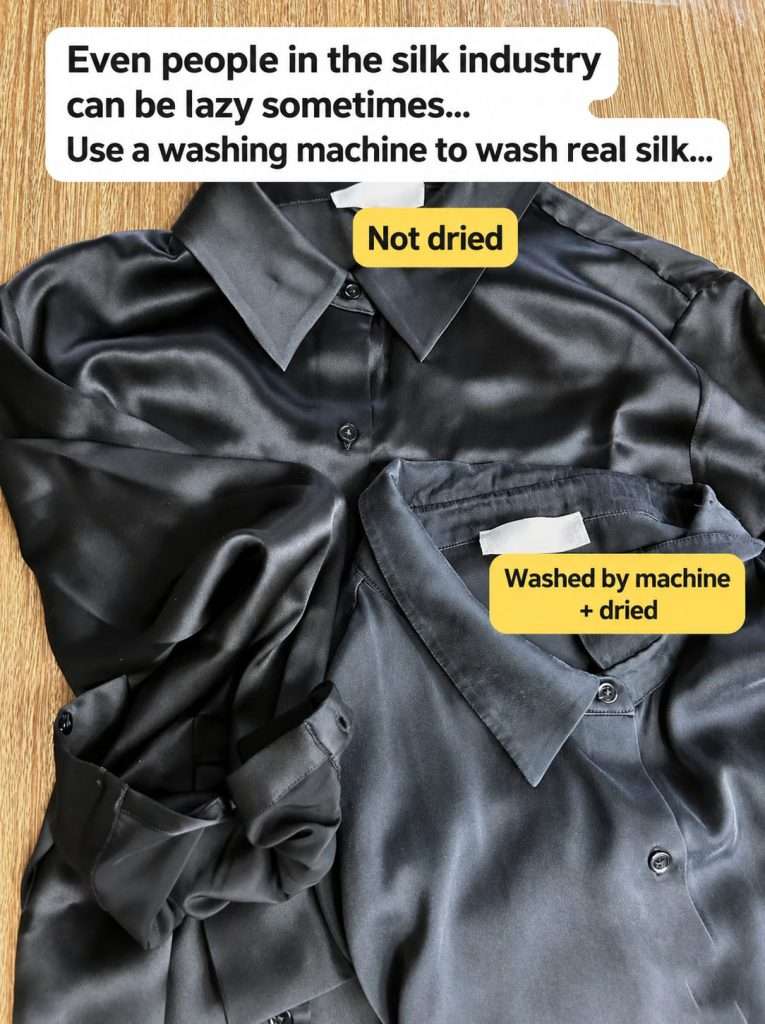
How to tell if silk is real: the quick answer
Forget the ring trick for a minute. To tell if silk is real, start with the fiber-content label and check exactly which parts of the product its silk claim covers. Shine, touch, price, momme, and certificates offer clues, but none can settle the question alone. A careful burn test on a seller-provided swatch can separate protein-like behavior from many imitations; it still can’t prove 100% Mulberry Silk by itself.
Use this order:
- Read the exact fiber percentage.
- Check every side, lining, filling, and accessory.
- Separate fiber, weave, weight, finish, and grade.
- Compare the fabric with a known silk sample.
- Ask for proof tied to the actual material.
- Burn only a loose thread or sacrificial swatch, if needed.
That order lacks the theater of dragging a scarf through a ring. It also works better. In our work with silk products, a specification usually tells us more than rubbing, squeezing, or performing small magic tricks with the fabric.
Our review covered January 2024 through August 2026 and included 27 buyer conversations in which customers explicitly questioned whether a product contained real, pure, natural, or synthetic silk. Ten buyers asked some version of “silk or satin?” That mix-up causes enough trouble to deserve an explanation before any testing begins.
Before testing silk, get the terms straight
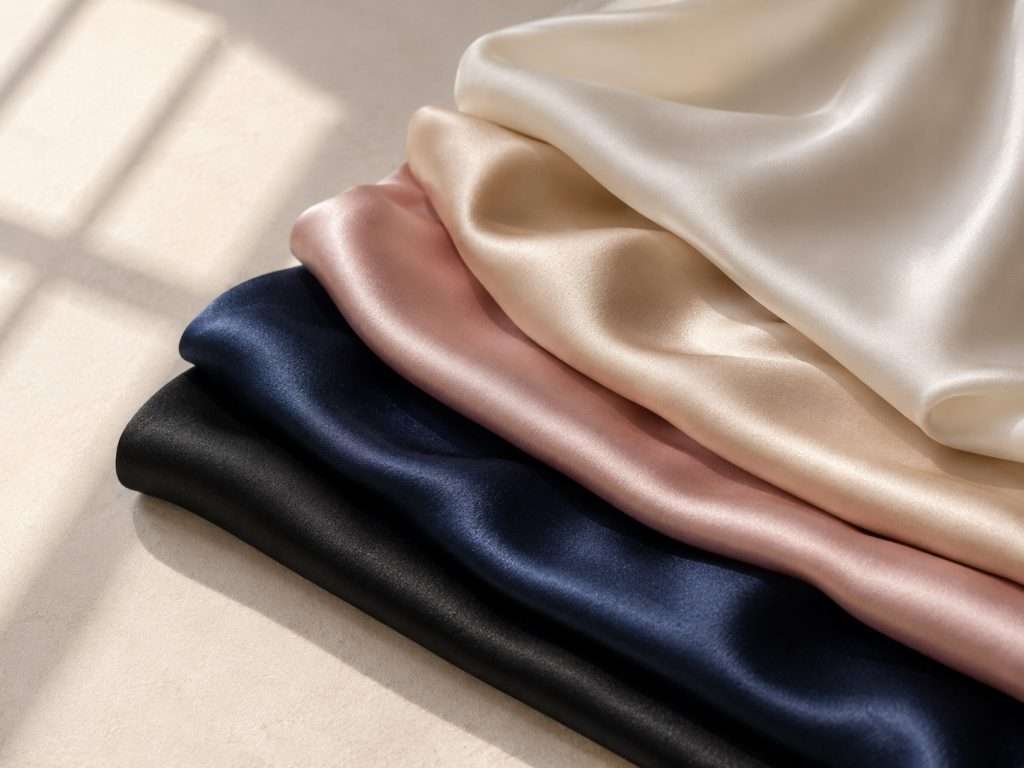
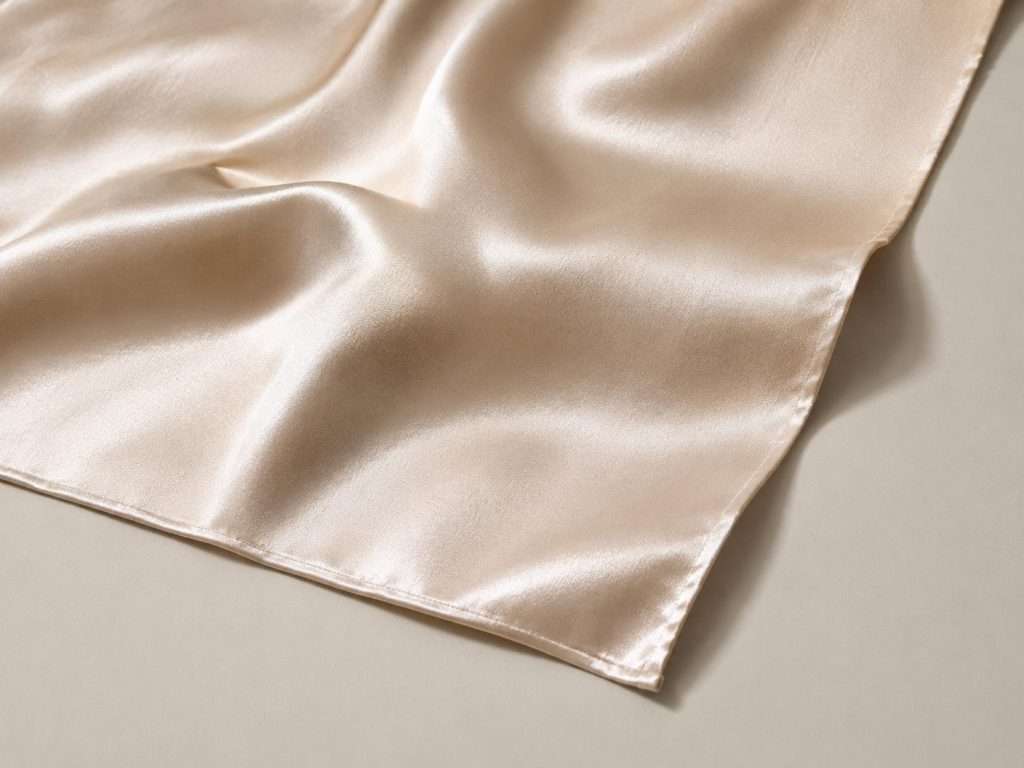
Silk names the fiber; satin names the weave.
Manufacturers can weave satin from silk, polyester, or another fiber. A glossy product photo shows how the surface reflects light, nothing more. Listings that say “satin,” “silky,” “silk touch,” or “luxury silk feel” leave the actual fiber content unanswered. Marketing copy has many talents. Fiber identification isn’t one of them.
| Term | What it tells you | What it does not prove |
|---|---|---|
| Silk | The claimed fiber is silk | Mulberry origin, purity, weight, or grade |
| Mulberry silk | The claimed silk comes from cultivated silkworms fed on mulberry leaves | That the claim is accurate or covers every component |
| Satin | The fabric uses a smooth, float-rich weave | Whether the fiber is silk or polyester |
| Charmeuse | A lightweight satin-weave fabric with a lustrous face and duller back | Fiber content unless the composition appears elsewhere |
| Momme | Fabric weight, commonly used for silk | Fiber identity or silk quality by itself |
| 6A | A quality-grade claim about raw silk | Finished-product composition or momme |
Comparing “real silk” with “satin” is like asking whether a shirt is cotton or striped. One describes the material; the other describes its construction. The useful comparison is silk fiber versus polyester, rayon/viscose, nylon, or a blend.
How to tell if silk is real, step by step
1. Read the fiber-content statement
Give the label the first chance to answer. Check the sewn-in tag, technical specification, or material field on the product page for a recognized fiber name and an exact percentage.
For genuine Mulberry Silk, look for wording such as:
Fiber content: 100% Mulberry Silk
“100% silk” claims pure silk fiber without naming the source. Tussah, Eri, and Muga all count as real silks. A buyer who specifically wants Mulberry Silk should find the word Mulberry in the composition or technical specification.
For products sold in the United States, FTC textile-label guidance says most covered textile products must disclose fiber content, country of origin, and the responsible manufacturer or dealer. Treat the label as first-line evidence, then compare it with the product description and invoice because a printed claim can still be wrong.
Buyers often accept “silk satin,” “silky,” or a title containing “silk” as a fiber declaration. Those phrases sound expensive. They don’t give a percentage.
2. Check which parts are actually silk
A product may use genuine silk alongside another material, and the construction can make perfect sense when the seller describes each part accurately.
Work through the product piece by piece:
- On a pillowcase, check the front, reverse, piping, and closure.
- For a bonnet or hair wrap, ask about the outer shell, hair-contact side, elastic channel, and any absorbent layer.
- A sleep mask has face fabric, backing, filling, and a strap.
- With garments, check the shell, lining, panels, trim, and belt.
- In a gift set, inspect every item, including the smaller accessories.
Historical internal bill-of-material records contained six mixed-material examples. They paired silk with a bamboo-derived reverse, cotton terry inner layer, or cotton lining. Such combinations don’t prove fraud; they show why “Which part is silk?” beats the much fuzzier “Is this a silk product?”
Seven buyer conversations raised the same issue. One set contained a silk item plus a polyester-satin accessory, yet the product name couldn’t explain the difference between the two pieces.
The glossy face of a pillowcase tends to get all the attention while the reverse slips past inspection. For hair-care products, confirm the fiber on every surface that touches the hair.
If you source finished goods, our pages for custom silk pillowcases and silk accessories show several constructions that call for section-by-section specifications.
3. Separate composition from momme, weave, finish, and grade
A sound silk specification answers several separate questions. Problems start when a listing asks one impressive number to answer all of them.
| Specification field | Example answer | Why it matters |
|---|---|---|
| Fiber content | 100% Mulberry Silk | Identifies the claimed fiber |
| Weave or construction | Charmeuse, twill, crepe, habotai | Changes sheen, texture, and drape |
| Weight | 19 momme or a stated GSM | Describes fabric mass, not identity |
| Finish | Sandwashed, printed, dyed | Can change luster and hand feel |
| Grade claim | 6A raw silk | Describes a claimed raw-material quality tier |
| Component scope | Silk face; other-fiber reverse | Shows where each material appears |
A 22-momme claim can’t identify a fiber. Sellers can attach an impressive-sounding weight to polyester too, and “6A” can’t replace the fiber percentage. Composition, weave, weight, finish, grade, and component scope each have a different job.
Real silk may look glossy, softly lustrous, or quite restrained. Sandwashing reduces its shine; crepe constructions look different from silk charmeuse, and a thin fabric can still contain genuine silk. We have handled real silk below the common 16–30 momme range used for many satin-weave bedding products. A low number gives you a reason to ask about the intended use, not grounds for an instant fake-silk verdict.
Some shoppers compare two pillowcases by momme even though one seller never names the fiber. Settle the composition first. Weight matters after that.
4. Use appearance and touch as comparison clues
Now pick up the fabric, but don’t give your fingertips a laboratory coat.
Many silk fabrics show a soft luster that shifts as the viewing angle changes, while polyester satin often looks uniformly glossy. Real silk may feel cool on first contact and then warm in the hand. Its drape tends to flow, with a little more surface grip than very slick polyester.
These observations help. They don’t amount to proof.
The ring test, wrinkle test, water-drop test, static test, and “silk squeak” all change with fabric thickness, weave, finishing, humidity, and the tester’s frame of reference. Fine polyester can glide through a ring; heavy genuine silk can bunch up and fail the same trick.
A side-by-side comparison gives your hands a better chance. Place the unknown fabric next to a known 100% silk swatch with a similar weave and weight. Check both faces under the same light, then compare the drape, sound, warmth, and surface grip.
Comparing sandwashed silk with shiny polyester satin tells you mostly that one fabric has a matte finish. Match like with like before drawing conclusions.
Our silk fabric page shows how much construction changes appearance. Charmeuse, crepe, twill, and sandwashed silk shouldn’t look or feel identical.
5. Ask for evidence that matches the product
Nine buyers in our review asked for more than a verbal promise. Their requests included swatches, close-up photos, video, certificates, and composition reports. The best request was plain: send the test report for the exact material used.
For an online purchase, ask the seller for:
- Exact fiber percentages, with recognized fiber names.
- The composition of every part that matters.
- Clear photos showing the sewn-in label and both faces of the fabric.
- Momme or GSM listed separately from the composition.
- A swatch when the value of the order warrants one.
- A return or dispute route if the item differs from its description.
An OEKO-TEX® STANDARD 100 certificate answers a specific safety question. OEKO-TEX describes STANDARD 100 as harmful-substance testing for a certified textile article and its components. The certificate doesn’t identify the fiber on its own, so check its number and scope, then request separate evidence for composition.
Keeping those questions separate prevents circular email. A safety certificate addresses the stated safety scope; a fiber label or suitable composition report tells you what the material claims to contain or what a lab measured.
Evidence also needs a clear link to the product. A report for white sample fabric may say little about a printed style from another lot, so ask how the document connects to the product, color, sample, or batch you plan to buy.
Private-label orders should put composition, weave, weight, finish, color, component mapping, and approved swatch details into the quotation or order specification. Our custom silk products page covers product categories where buyers should settle those fields before production.
6. Perform a silk burn test only on a loose thread or swatch
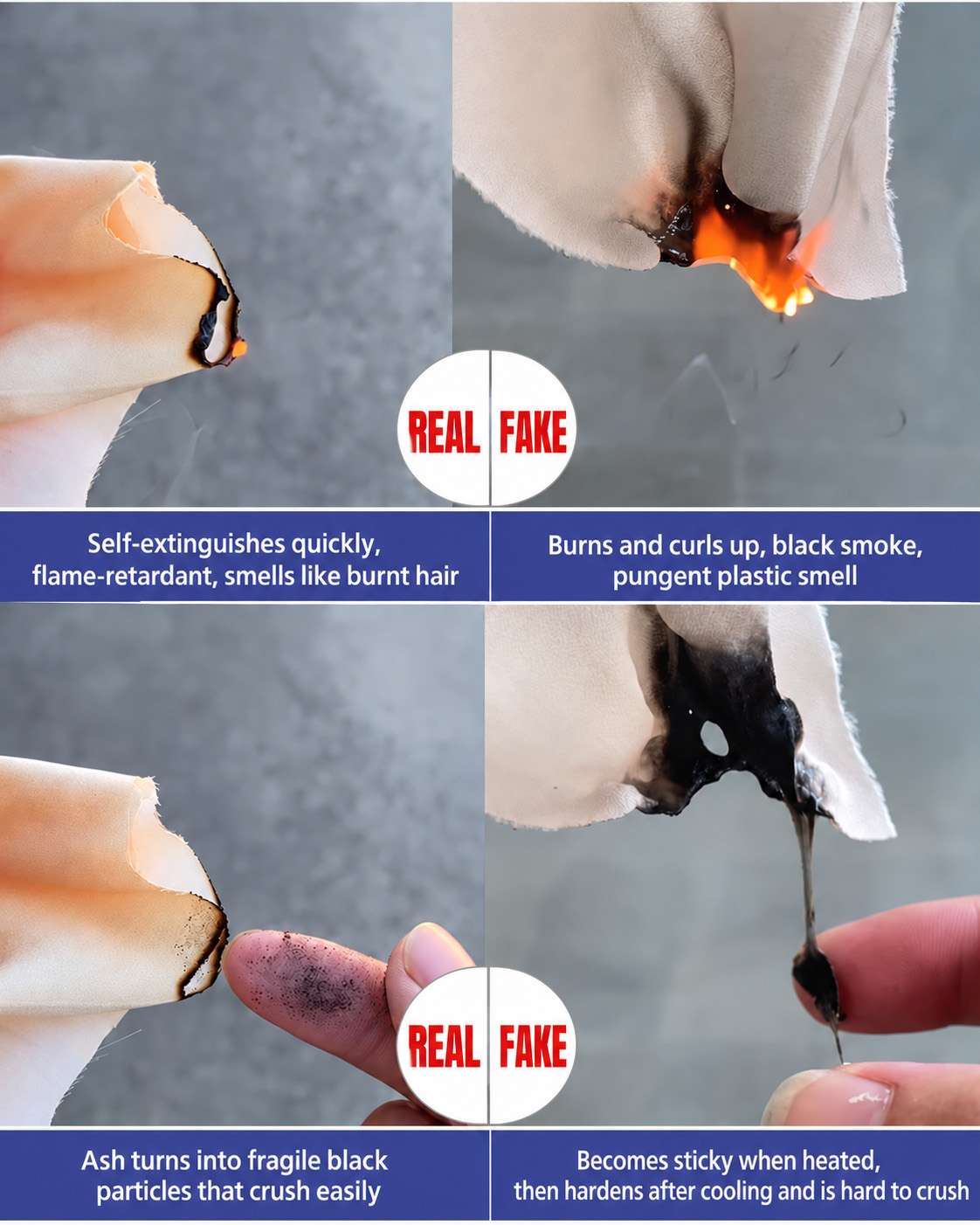
A burn test can separate broad fiber families, though it destroys the sample and leaves plenty of room for misreading the result. Fire remains a rather blunt laboratory instrument.
Keep flames away from finished pillowcases, scarves, garments, and bedding. Ask for a spare swatch or take one tiny loose thread from an inconspicuous seam. Use metal tweezers, work well away from combustible material, and keep water within reach. Anyone uncomfortable with an open flame should skip the test.
Watch four things: the reaction near the flame, the way the fiber burns, its odor, and the residue.
| Fiber behavior | Near or in the flame | Odor | Residue |
|---|---|---|---|
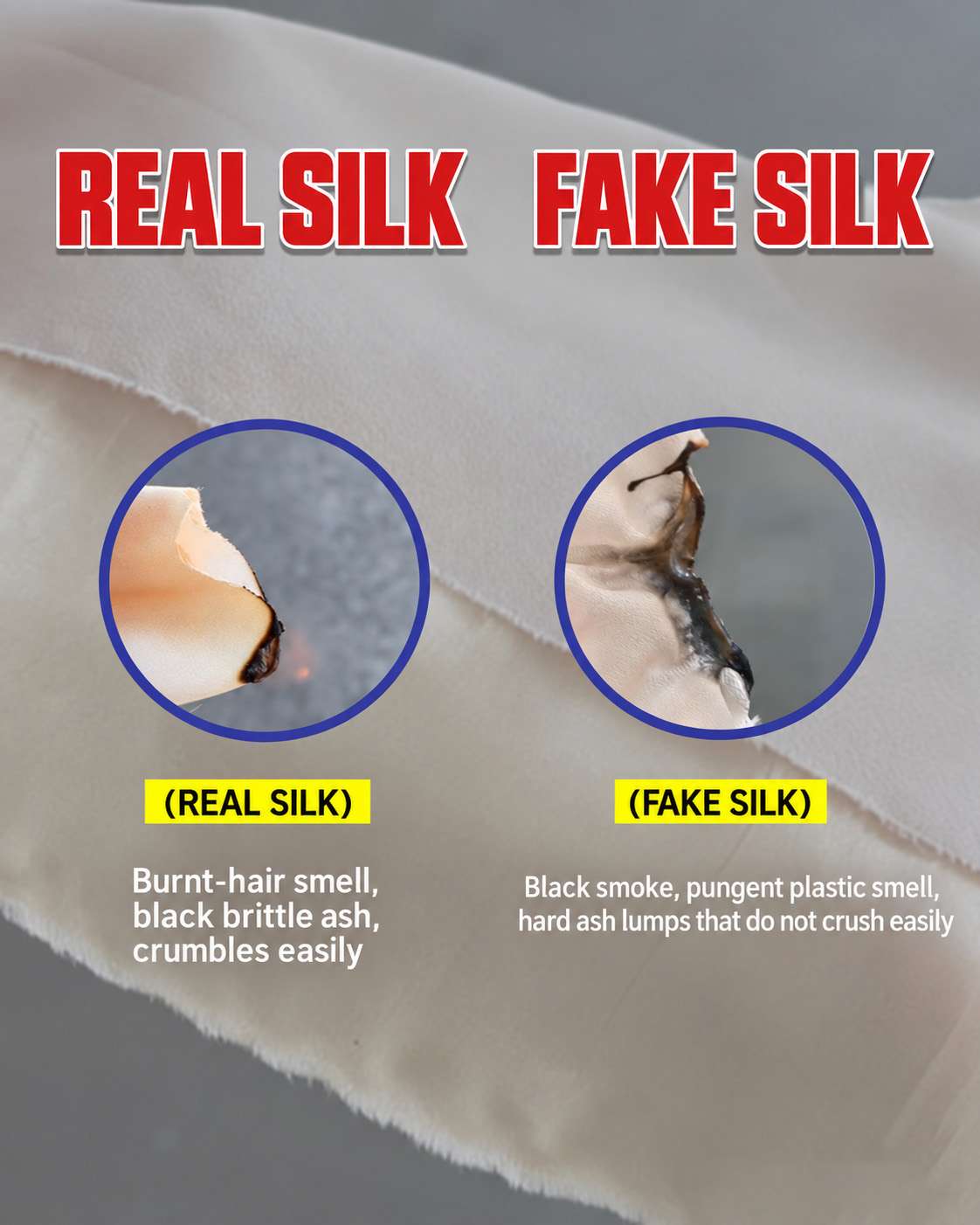
| Silk or another protein fiber | Shrinks away, burns slowly, may self-extinguish | Burning hair | Small dark mass that crushes easily |
| Cotton, linen, rayon, or viscose | Ignites and continues burning more readily | Burning paper | Light, soft ash |
| Polyester or nylon | Shrinks and melts | Chemical or plastic-like | Hard melted bead |
Use the table for screening, not a final verdict. The Canadian Conservation Institute warns that blends complicate burn-test results and that the test can’t reach a firm conclusion on its own. Wool is a protein fiber and may also smell like burning hair. Finishes, dyes, mixed warp and weft yarns, and contamination can distort what you see.
When one part chars and another melts, resist the urge to average the results. The sample could contain a blend, separate yarns, sewing thread, or multiple layers. Test parts separately only if you can take samples without damaging the item.
Sewing thread creates another easy trap. Its composition may differ from the face fabric, lining, and shell, so burning the thread tells you about the thread.
Which silk authenticity tests are most useful?
| Check | Best use | Reliability limit |
|---|---|---|
| Fiber-content label | First screening step | A claim can be wrong or incomplete |
| Component-by-component specification | Finding mixed constructions | Depends on seller accuracy |
| Known-swatch comparison | Spotting obvious differences | Weave and finish can fool the eye and hand |
| Swatch burn test | Separating protein-like, cellulose-like, and thermoplastic behavior | Destructive; blends and wool can confuse results |
| Price | Prompting further questions | Never proves fiber identity |
| Momme or 6A wording | Comparing declared silk specifications | Doesn’t authenticate fiber |
| OEKO-TEX STANDARD 100 | Checking stated harmful-substance certification scope | Doesn’t certify silk composition |
For an ordinary consumer purchase, look for agreement among the label, component description, seller’s answers, sample appearance, and burn behavior. That combination usually supports a practical decision. An expensive order, wholesale dispute, or contract may justify written confirmation from a textile laboratory, which can identify the fiber type or measure a blend. Make sure its report names the specimen the laboratory tested.
Common mistakes when identifying real silk
Treating satin as a fiber
Satin may contain silk or polyester. Ask for the composition.
Expecting every real silk fabric to shine
Weave and finishing alter luster. Sandwashed silk and crepe can look restrained beside charmeuse without being fake.
Believing high momme means genuine silk
Momme describes weight. It can’t name the fiber, however authoritative the number looks on a product page.
Letting a low price settle the question
A surprisingly low price deserves scrutiny, but discounts, size, weight, construction, and sales channel all affect it. Three buyer cases linked price pressure with either a synthetic substitute or the rejection of genuine silk. That pattern says something about purchasing decisions, not fiber identity.
Checking only the easiest surface
Turn the item over, read the lining label, and find out which surfaces touch the hair or skin. Check every item in a set as well. The reverse rarely appears in the glamorous product shot, but it still comes in the parcel.
Calling one home test definitive
Appearance, touch, and flame behavior can all mislead. Build the case from several checks that point in the same direction.
A practical online buying checklist
Copy these questions into the seller chat before you pay:
- What is the exact fiber content by percentage?
- Is the material Mulberry Silk or another type of silk?
- Which sides, layers, linings, and accessories does that composition cover?
- What are the weave, momme or GSM, and finish?
- Can you provide photos of the fiber label and both faces of the fabric?
- Can you send a swatch, and does any report apply to that exact material?
A clear supplier should answer without blending “silk,” “satin,” “momme,” and “6A” into one foggy quality claim. If you’re developing custom silk sleepwear, record the answers in the approved specification before sampling.
Frequently asked questions
How can you tell if silk is real without burning it?
Read the fiber-content label, confirm the material used in each component, compare both faces with a known silk swatch, and ask for evidence tied to the fabric. Together, these checks can support a sound practical judgment, though sight and touch can’t guarantee fiber composition.
Does a 100% silk label mean the fabric is Mulberry Silk?
No. “100% silk” claims pure silk fiber without identifying its source. Buyers seeking genuine Mulberry Silk should look for “100% Mulberry Silk” in the composition or specification.
Is satin fake silk?
No. Satin is a weave, not a fiber. Silk yarn makes silk satin; polyester yarn makes polyester satin. The word “satin” alone leaves the fiber question open.
Is the silk burn test definitive?
No. Silk usually burns slowly, smells like burning hair, and leaves a crushable dark residue. Wool behaves in a similar way, while blends can produce mixed results, so use a swatch burn test only as supporting evidence.
Does OEKO-TEX prove that silk is real?
OEKO-TEX STANDARD 100 covers harmful-substance testing within the certificate’s stated scope. It doesn’t independently prove that a product contains silk, Mulberry Silk, 100% silk, or the stated momme.
Can real silk contain non-silk parts?
Yes. A product may put silk on the face and another material on the reverse, lining, padding, trim, or accessory. The construction remains legitimate when the seller describes each component accurately.
Need help checking a silk specification?
Send us the product type, intended composition, weave, weight, finish, and the surfaces that must use silk. The JacketTex team can turn a vague material description into a specification that’s easier to sample, compare, and verify.